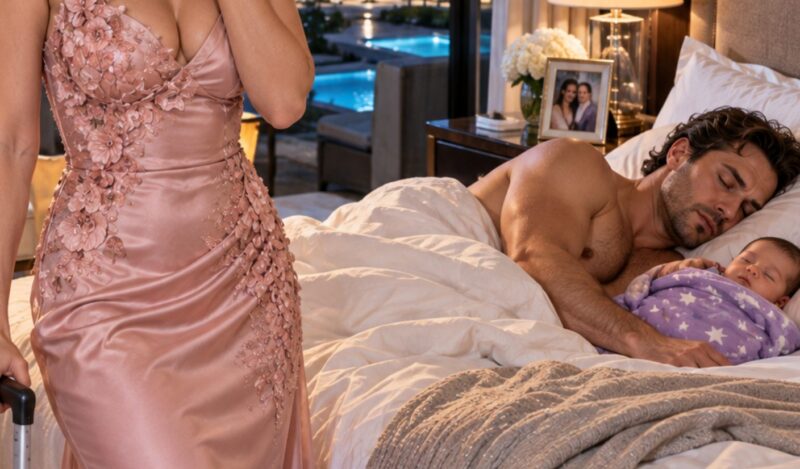
The mark was barely wider than my thumbnail—a faint reddish crescent beneath the baby’s left ear.
I froze.
When I was born, my mother used to trace that exact mark on my neck and call it an angel’s thumbprint. Mine had faded with age, but I remembered it clearly from the photographs of my childhood.
I looked at the sleeping baby, then at my husband, Eric.
The color had drained from his face.
“Why does he have my birthmark?”
Eric closed his eyes.
That was when I knew there was a secret.
The baby wasn’t just marked like me. His nose, jaw, upper lip, and eyes reminded me of old photographs of myself.
I took a step backward.
“How long have you known?”
“Four days.”
“You’ve had a newborn in our house for four days while I was in New York?”
“Yes.”
“Who is he?”
“His name is Owen.”
“I asked who he is.”
Eric finally told me the truth.
Six days earlier, he had received a call from a hospital in Cleveland. A dying woman named Rebecca Hale had demanded to speak with him.
Rebecca had been his foster sister.
They had lived in the same foster home as children, but Eric had never told me about her. She had recently given birth to Owen and named Eric as his guardian. After a catastrophic car accident, she died.
Then Eric revealed something even more devastating.
He had seen Rebecca the previous year, shortly after my miscarriage.
“Why?”
“Because she knew a secret about your mother.”
Rebecca’s biological mother, Laura Hale, had left her a locked box. Inside were photographs, hospital records, letters from my mother, Margaret, and a birth certificate bearing my name.
I laughed when Eric told me.
“My mother gave birth to me.”
“No,” he said quietly. “She raised you. But she was never pregnant with you.”
Margaret had lost her own baby at thirty-six weeks. At the hospital, she met seventeen-year-old Laura, who had given birth to a healthy daughter but was terrified that her strict family would reject her.
Margaret and my father, Daniel, secretly took the baby home. A private adoption followed, and the records were sealed.
That baby was me.
Laura later married and had Rebecca, making Rebecca my biological half-sister.
I had discovered a sister I never knew existed—only after she was already dead.
I locked myself in the bathroom and cried.
I cried for the mother who had hidden the truth. For Laura. For Rebecca. And for Eric, who had known for eleven months.
When I confronted him, he admitted he had kept the secret because Rebecca was sick and because she had become pregnant. He had hoped that, eventually, she might ask us to take Owen.
After my miscarriage, he was afraid that telling me would destroy me all over again.
“You do not get to decide which truths I am strong enough to survive,” I told him.
I slapped him and ordered him to leave.
Before he went, he handed me a letter from Rebecca.
She explained that she had initially been afraid to contact me. Eric had wanted to tell me immediately, but she had begged him to give her time. After my miscarriage, they had both decided to remain silent.
It had been a shared mistake.
But Rebecca had left me another warning.
Her heart condition might be genetic.
She urged me to get tested.
I did.
Within days, a cardiologist diagnosed me with mild, treatable dilated cardiomyopathy. The dizziness and heart palpitations I had dismissed as stress suddenly had a different meaning.
For the next month, Eric lived nearby. We spoke only about Owen and practical matters.
I was beginning to love the little boy, even as I resented the circumstances that had brought him into my life.
Then the story became public.
A leaked guardianship petition sparked gossip articles claiming that Owen was Eric’s secret love child. At an emergency board meeting, my chairman asked whether the baby was Eric’s.
“No,” I said. “He is my nephew. I recently discovered that I was adopted. His mother was my biological half-sister, and she died in Ohio. I am claiming him.”
I refused to step down or apologize for my family.
That evening, a box from Rebecca’s estate arrived at my house.
Inside was another letter—this one from Margaret, written twenty-two years earlier.
She confessed that she had always intended to tell me about my adoption, but every major event in my life had given her another reason to delay.
Eventually, silence had become easier than the truth.
Then came the final revelation.
Laura had not chosen Margaret and Daniel randomly.
My biological father was Daniel’s younger brother, Michael.
Michael had been Laura’s lover. She became pregnant with me, but before he could take responsibility, he died in a boating accident at twenty-four.
Daniel learned the truth afterward and raised me as his own daughter.
My adoptive father had therefore also been my biological uncle.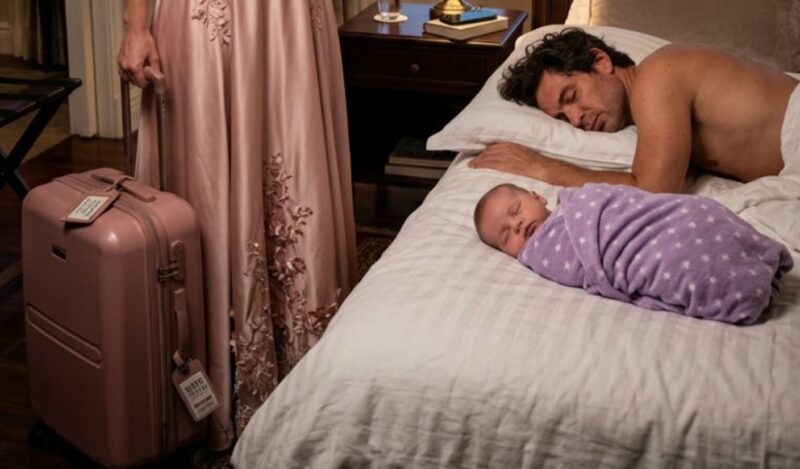
At the bottom of Rebecca’s box was one final note.
She had discovered the truth while researching Daniel’s family tree. One person was still alive who knew everything:
My Aunt Evelyn.
I called her.
She confirmed the story and apologized for staying away after Daniel’s death.
Then she told me something I desperately needed to hear.
“Daniel was your father. He knew Michael gave you life, but he never confused that with who raised you. Margaret was your mother. Laura was your mother in a different, tragic way. You do not have to amputate one family to make room for another.”
For the first time, the pieces of my life began to fit together.
A year passed.
Eric and I did not magically repair our marriage. We went through counseling, kept our finances separate for a time, and learned how to live with the damage his secrecy had caused.
He learned to answer my questions without trying to control my reactions.
I learned that accepting his help with Owen did not mean surrendering my independence.
The court made us co-parents.
Owen’s nursery became a collection of the people whose lives had created his: Rebecca, Laura, Margaret, and Daniel.
One autumn day, we traveled to Ohio with Aunt Evelyn and visited Rebecca’s grave.
I held Owen against my hip and touched the cold headstone.
“I’m still angry with you,” I whispered. “I think I always will be, for not calling me yourself.”
I paused.
“But I love you, too.”
I looked at Eric.
“You gave me back my history. You gave me this boy. And you completely blew up my marriage.”
He smiled sadly.
“I forgive you for being afraid,” I told Rebecca. “I don’t forgive the lie. But I refuse to let it own the rest of my life.”
That night, Owen woke crying.
Eric started to get up, but I stopped him.
“I’ve got him.”
A year earlier, he would have decided what I needed without asking.
Now he simply looked at me.
“Are you sure?”
“I’m sure.”
I lifted Owen from his crib and carried him toward the hotel window. Rain streaked the glass, and our reflections blurred together.
For thirty-five years, I had believed family was a straight line:
Mother. Father. Daughter.
Now I understood that family was something far more complicated—a geography of scars.
People lie. They hide things. They make terrible choices while believing they are protecting the people they love.
The damage is real.
But so is the love.
Owen reached up and touched my cheek.
I kissed his temple.
“You have a wildly complicated family, little man.”
Behind me, Eric approached and waited.
He no longer tried to control me.
He simply waited for an invitation.
“Come here,” I said.
He joined us and rested his hand gently against my back.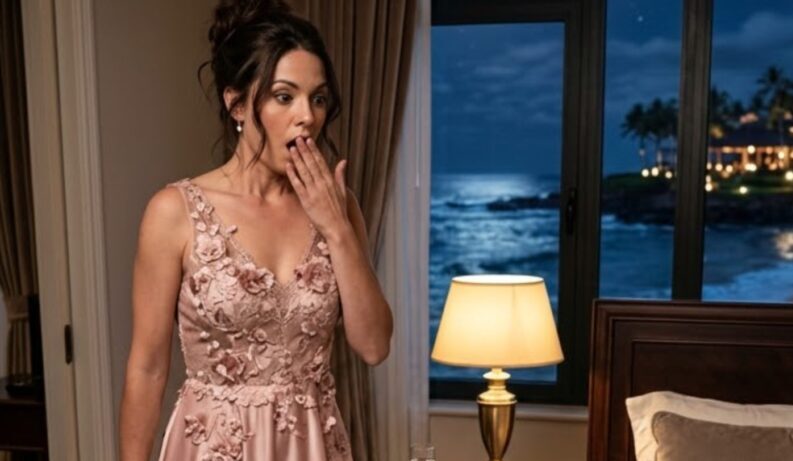
I looked down at the pale-red crescent beneath Owen’s ear.
Once, that mark had seemed like a warning.
Now, it felt like an anchor.
It wasn’t proof that blood controlled destiny, nor was it an excuse for the lies people told in the name of love.
It was simply a reminder that no matter how deeply the truth is buried—no matter how many records are changed, letters burned, or silences enforced—the truth always leaves a mark.
And sometimes, if you are lucky, it arrives in the middle of the night, sleeping peacefully in your arms.