“You’re Nothing Without Us!” My Father Threw Me Out at 17. Nine Years Later, My Parents Came Begging for $400,000.
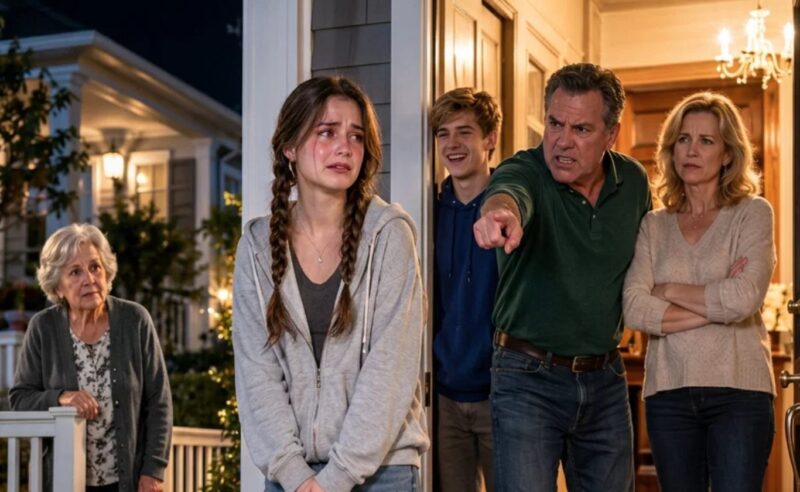
“GET OUT! YOU’RE NOTHING WITHOUT US!” my father screamed as he hurled my backpack onto the porch.
I was only seventeen.
My mother stood by the doorway, watching without saying a word, while my younger brother laughed from the window. I stood outside trembling, tears streaming down my face, with nowhere to go and nowhere to sleep.
Then our seventy-one-year-old neighbor, Mrs. Eleanor Whitaker, stepped outside and whispered five words that would change my life forever:
“You can stay with me.”
I broke down in tears.
Nine years later, my parents walked into my office asking me for $400,000. My father wore a confident smile, certain I would help them.
That smile vanished when I turned my laptop toward him.
His face went pale.
My name is Sarah Mitchell, and nine years ago, five simple words saved me from homelessness.
My parents had never wanted a daughter with dreams of her own. They wanted someone obedient—someone who would cook, clean, and never complain.
My younger brother, Tyler, was treated like royalty. He received a new car at sixteen, expensive clothes, and private tutoring. I received secondhand textbooks and lectures about how lucky I should feel to have anything at all.
Everything changed when I earned a full academic scholarship to a prestigious university.
Instead of congratulating me, my father, Richard, demanded that I turn it down.
“You’re staying here and helping with the family business,” he declared.
My mother immediately sided with him.
“Tyler needs your help more than you need college,” she said.
For once, I refused to obey.
That was my crime.
The following evening, my father stuffed my clothes into an old backpack and threw it onto the porch.
“You’re nothing without us!” he shouted.
My mother watched from the doorway. My brother laughed from the window.
I stood there for twenty minutes, too shocked to move, before our neighbor, Eleanor Whitaker, came outside.
Eleanor was a seventy-one-year-old widow who lived in a small white house next door. She had always been kind to me, sometimes leaving homemade cookies at our door or asking how my studies were going.
That night, she looked at me standing in the cold with my backpack and asked what had happened.
I could barely speak.
Without asking another question, she said, “Come with me, sweetheart.”
“I don’t have any money,” I sobbed.
She gently picked up my backpack.
“Sweetheart, I didn’t ask.”
Inside, she made me hot chocolate and wrapped a warm blanket around my shoulders. For the first time that night, I felt safe enough to cry without being afraid of someone yelling at me.
Eleanor didn’t simply offer me a place to sleep. Because I was still seventeen, she contacted a trusted family attorney to help arrange temporary care and ensure that the proper legal authorities were involved. Within days, the necessary arrangements for legal guardianship were underway.
For the first time in my life, someone asked me what I wanted to become.
“An engineer,” I whispered.
She smiled warmly.
“Then we’ll make you an engineer.”
At the time, I had no idea that Eleanor was carrying a secret of her own—one that would eventually change both our lives.
Living with Eleanor felt like stepping into another world.
Nobody shouted when I studied late. Nobody demanded my scholarship money. Nobody called me worthless for having ambitions.
She encouraged every dream my parents had dismissed.
When I turned eighteen, she helped me open my own bank accounts, apply for additional financial aid, and move into university housing.
I majored in mechanical engineering, determined to build a future that belonged entirely to me.
Every Sunday, Eleanor called to ask whether I had eaten properly and gotten enough sleep.
“Even geniuses need rest,” she would remind me.
Those conversations made me laugh more than I had throughout my childhood.
Meanwhile, my parents never contacted me.
Not on my birthday.
Not on graduation day.
Not even when I landed my first engineering job.
For years, I wondered how parents could abandon their own child so completely. Eventually, I stopped searching for an answer that might never come.
Four years after leaving home, I graduated.
Eleanor sat in the audience wearing a ridiculous purple hat, crying louder than anyone around her.
When I walked across the stage, she stood and applauded as though I had accomplished something extraordinary.
Afterward, she hugged me tightly.
“I’m so proud of you, Sarah.”
Those words meant almost as much as the first five she had spoken to me.
Three years after graduating, I took another leap of faith and founded a company that designed industrial energy-efficiency systems.
It was a risky decision, but Eleanor believed in me.
Having worked as an accountant for decades, she helped me understand financial projections, negotiate contracts, and recognize the dangers of predatory investors.
She wasn’t extraordinarily wealthy, but she understood business better than anyone I knew.
Her advice was practical, her encouragement unwavering, and her belief in me never depended on whether I succeeded.
Slowly, my company began to grow.
We secured several major manufacturing clients, expanded our operations, and hired more employees.
By the time I turned twenty-five, I had a team of thirty-two people working alongside me.
For the first time, I wasn’t merely surviving.
I was building something meaningful.
And my parents still had no idea.
Then Eleanor became seriously ill.
During one hospital visit, she held my hand and told me that she had revised her estate plan years earlier.
After her death, her modest house and remaining savings would pass to me.
I immediately protested.
“Eleanor, I don’t need your house. You’ve already given me so much.”
She smiled faintly.
“I know, sweetheart. That’s exactly why I trust you with it.”
Six months later, she passed away peacefully.
I was devastated.
Her funeral brought together neighbors, former colleagues, and people whose lives she had touched through small, quiet acts of kindness.
My biological parents didn’t attend.
Not that I expected them to.
After Eleanor’s death, I kept her house exactly as she had left it. Her old yellow curtains still hung above the kitchen sink, and her favorite teacup remained beside the window.
It was the closest thing I had to feeling that she was still there.
Two months later, my parents suddenly appeared at my company’s headquarters.
My father wore an expensive suit. My mother carried a designer handbag. Tyler walked behind them, glancing around my office with undisguised curiosity.
“Sarah! We’ve missed you!” my mother exclaimed, opening her arms as though we had seen each other the previous weekend.
I stared at her.
“Nine years is a long time to miss someone without making a single phone call.”
My father laughed awkwardly.
“Families have disagreements. We all make mistakes.”
Tyler looked around my office.
“So, are you actually making money with this business?”
I understood immediately.
They hadn’t come to apologize.
They wanted something.
My father sat down without waiting for an invitation and explained that the family business was struggling. They needed a temporary investment to keep it afloat.
“How much?” I asked.
He hesitated for a moment.
“Four hundred thousand dollars.”
My mother quickly added that she had heard Eleanor left me her house.
“You could use it as collateral,” she suggested. “It’s just sitting there. This could help everyone.”
For a moment, I couldn’t speak.
They wanted me to mortgage the home of the woman who had saved me so they could rescue the people who had thrown me out.
My father leaned forward.
“Eleanor helped you because we raised you properly. Everything you’ve accomplished started with us.”
I looked directly at him.
“You threw me out of your house when I was seventeen.”
He shrugged.
“We taught you independence.”
Tyler rolled his eyes.
“Stop acting like a victim, Sarah. You’re rich now. It’s not like you’ll miss the money.”
I slowly opened my laptop.
My father smiled, apparently convinced that I had finally agreed to help.
Then I turned the screen toward him.
His smile disappeared.
The screen displayed a financial report on Mitchell Industrial Supply, the company he had owned for twenty years.
Three months earlier, his business had approached mine about a major equipment contract. Before entering any agreement, our compliance department had reviewed the company’s financial condition.
The findings were deeply troubling.
Unpaid suppliers.
Overdue business loans.
Revenue projections that appeared significantly exaggerated.
And something far more serious: unauthorized use of my name as a supposed adviser to the company.
I looked at my father.
“Why is my name in your financing documents?”
His face lost its color.
“That’s just paperwork,” he muttered.
“Paperwork submitted to a lender?”
He said nothing.
Tyler stopped smiling.
My mother whispered my father’s name, her voice suddenly trembling.
My father had represented that I was involved in his business and would support its expansion—even though he hadn’t spoken to me in nine years.
My lawyer had already notified the lender that I had never authorized those representations. The lender was independently investigating the matter and assessing its exposure.
I closed the laptop halfway.
“You didn’t come here because you missed me. You came here because your business is failing, and you thought you could use my money, my house, and my reputation to save it.”
My father slammed his fist against my desk.
“You wouldn’t destroy your own father!”
I stood up.
“No. I won’t let you use my reputation to rescue yourself.”
My mother began to cry.
“Sarah, please. We’re family.”
I looked at her, remembering the girl I had been nine years earlier, standing on the porch with a single backpack.
“Where was my family when I had nowhere to sleep? Where was my family when Eleanor helped me pay for textbooks? Where was my family when I graduated? Where was my family when I built this company?”
Nobody answered.
Tyler muttered, “You think you’re better than us.”
I shook my head.
“No. I finally understand that I deserved better.”
Then I called my assistant and asked her to escort them out.
My father threatened to regret it. My mother kept crying. Tyler refused to look at me.
I watched them leave without offering another word.
For the first time in nine years, I felt no need to prove anything to them.
Two months later, their lender refused to provide further financing after its investigation.
Without the money they had expected, Mitchell Industrial Supply entered insolvency proceedings, and my father lost control of the business he had spent years presenting as successful.
Tyler, who had enjoyed a generous salary from the family company, was forced to find work elsewhere.
My parents eventually sold their luxury home and moved into a small rental apartment.
They blamed me for everything.
But I hadn’t taken their money.
I hadn’t sabotaged their business.
I had simply refused to give them mine.
Three months later, my father mailed me a letter.
It contained only a few lines.
“We made mistakes. But we gave you life. Surely that means something.”
I read it at Eleanor’s kitchen table, beneath the old yellow curtains that still hung above the sink.
Her favorite teacup sat beside the window.
I picked up a pen and wrote a single sentence.
“You gave me life. Eleanor taught me how to live it.”
Then I mailed the letter and moved on.
A year later, I established the Eleanor Whitaker Scholarship Fund to help teenagers facing family abandonment and housing insecurity.
I wanted other young people to have the opportunities Eleanor had fought to give me.
The fund’s first recipient was a seventeen-year-old girl who dreamed of becoming an engineer.
When she arrived at the scholarship ceremony, she was carrying a faded backpack.
I nearly cried.
After the ceremony, she approached me and asked, “Why are you helping me?”
I thought about Eleanor standing on her porch nine years earlier, looking at a frightened girl who had nowhere else to go.
Then I smiled.
“Because someone once helped me.”
That evening, I sat on Eleanor’s porch and watched the sun sink below the horizon.
Her house was still mine. My company was thriving. The scholarship fund was helping young people build futures that nobody could take away from them.
For nine years, I had believed revenge meant becoming successful enough to make my parents regret rejecting me.
But sitting there, surrounded by the quiet memories of the woman who had saved me, I finally understood something.
My parents had lost a daughter who would have loved them unconditionally.
I had gained a mother who never demanded that I earn her love.
They had thrown me away because I refused to live the life they had chosen for me.
Eleanor had opened her door because she believed I deserved the chance to choose my own.
My parents abandoned me with a single backpack, convinced I would never amount to anything.
Nine years later, they returned, desperate for the money and security I had built without them.
But my greatest victory wasn’t watching their business collapse.
It wasn’t refusing their demands or proving that I could succeed without them.
My greatest victory was the life I created, the kindness I chose to pass on, and the young people I could help because Eleanor had once opened her door to me.
She taught me that family isn’t defined by blood, obligation, or the people who claim to own your future.
It’s defined by the people who stand beside you when you have nothing to offer them.
And the five words that saved my life became the legacy I would carry for the rest of it:
“You can stay with me.”